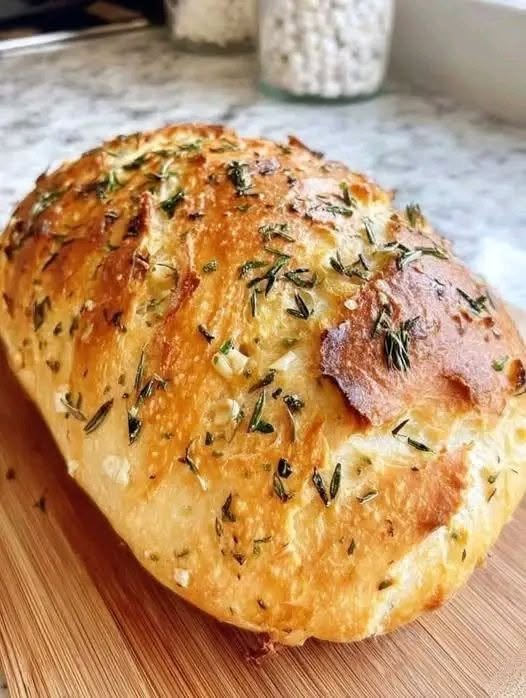
| Prep Time (Active) | 20 minutes |
| Rise / Fermentation Time | 3 to 18 hours (flexible depending on schedule) |
| Bake Time | 45 minutes |
| Total Time | ~4 hours (fast method) to 19 hours (overnight method) |
| Recipe Intensity / Skill Level | Beginner-Friendly (Low physical effort, medium patience) |
| Yield | 1 round boule (approx. 10–12 slices) |
Pro Tip on Intensity: You do not need a stand mixer or strong wrists for this dough. We use a gentle “stretch-and-fold” technique rather than traditional heavy kneading. The water and time do 90% of the gluten work for you.
Equipment Needed
-
Dutch Oven (4.5 to 6 quart): Cast iron or enamel-coated works best.
-
Large Mixing Bowl: Glass or ceramic preferred.
-
Parchment Paper: Essential for transferring the wet dough into a hot pot.
-
Sharp Knife or Razor (Lame): For scoring the loaf.
-
Measuring Scale or Cups: A digital kitchen scale yields the most consistent crust.
Ingredients
For the Garlic & Herb Infusion
-
1 full head of Garlic: Roasted soft (or 6 cloves fresh garlic, finely minced and sautéed briefly in olive oil until fragrant, not brown).
-
2 tablespoons Fresh Rosemary: Finely chopped (fresh is crucial here; dried rosemary turns needle-sharp and woodiness dominates).
-
1.5 tablespoons Extra Virgin Olive Oil: To coat the garlic and herbs.
For the Bread Dough
-
400 grams (approx. 3¼ cups) Unbleached All-Purpose or Bread Flour: Bread flour provides a slightly chewier structure, but all-purpose gives a soft, airy crumb.
-
1.5 teaspoons (9 grams) Fine Sea Salt or Kosher Salt: Do not cut back—salt controls yeast activity and provides essential structure and flavor.
-
½ teaspoon (2 grams) Instant Yeast or Active Dry Yeast: A small amount allows for a slow, flavorful ferment.
-
360 ml (approx. 1½ cups) Lukewarm Water: Ideal temperature is 95°F to 105°F (35°C to 40°C).
Step-by-Step Baking Method
Follow these sequential steps closely to ensure maximum rise and an open, airy crumb.
Storage & Shelf Life (“Last of the Recipe”)
Fresh artisan bread lacks commercial preservatives, meaning its shelf life depends entirely on how you store it:
-
Days 1–2 (Peak Crust Freshness): Store the cut loaf cut-side down on a wooden cutting board or inside an unsealed paper bag at room temperature. Avoid plastic bags on day one, as they trap humidity and turn the crispy crust rubbery.
-
Days 3–5 (Slicing & Toasting): Transfer to a bread box or sealed linen bag. By day 3, the crumb will naturally firm up—making it prime for slicing and running through a toaster or turning into garlic crostini.
-
Long-Term Storage (Up to 3 Months): Slice the entire cooled loaf, place parchment paper between slices, and seal tightly in a freezer-safe zip-top bag. Freeze immediately. Toast slices directly from frozen—they revive with original fresh-baked texture!
Reheating Tip: To crisp up a whole 2-day-old loaf, splash the exterior crust lightly with water and bake in a preheated 375°F (190°C) oven for 8–10 minutes.
Complete Nutritional Information
Nutritional values are calculated per serving based on 10 slices per loaf.
| Nutrient | Amount Per Serving (1 Slice / ~65g) | % Daily Value* |
| Calories | 175 kcal | — |
| Total Fat | 2.5 g | 3% |
| Saturated Fat | 0.4 g | 2% |
| Trans Fat | 0 g | — |
| Cholesterol | 0 mg | 0% |
| Sodium | 350 mg | 15% |
| Total Carbohydrate | 32 g | 12% |
| Dietary Fiber | 1.8 g | 6% |
| Sugars | 0.5 g | — |
| Protein | 5.5 g | 11% |
| Calcium | 18 mg | 2% |
| Iron | 2.1 mg | 12% |
| Potassium | 65 mg | 1% |